Challenge
Elinta Charge makes premium public EV charging stations. To sell into new markets and meet operator requirements, its chargers had to support four things: California pricing for US certification, Eichrecht-compliant metering for Germany, OCPP security profiles, and remote firmware updates. Each had to be checked against a working backend before release.
How they used TimeTick
Elinta connected its chargers and virtual simulators to TimeTick and worked through each requirement as a test. TimeTick sent the OCPP commands, recorded every message in both directions and checked the responses against expected results, so the team could see exactly where a charger or a configuration went wrong.
1. Market entry: California pricing
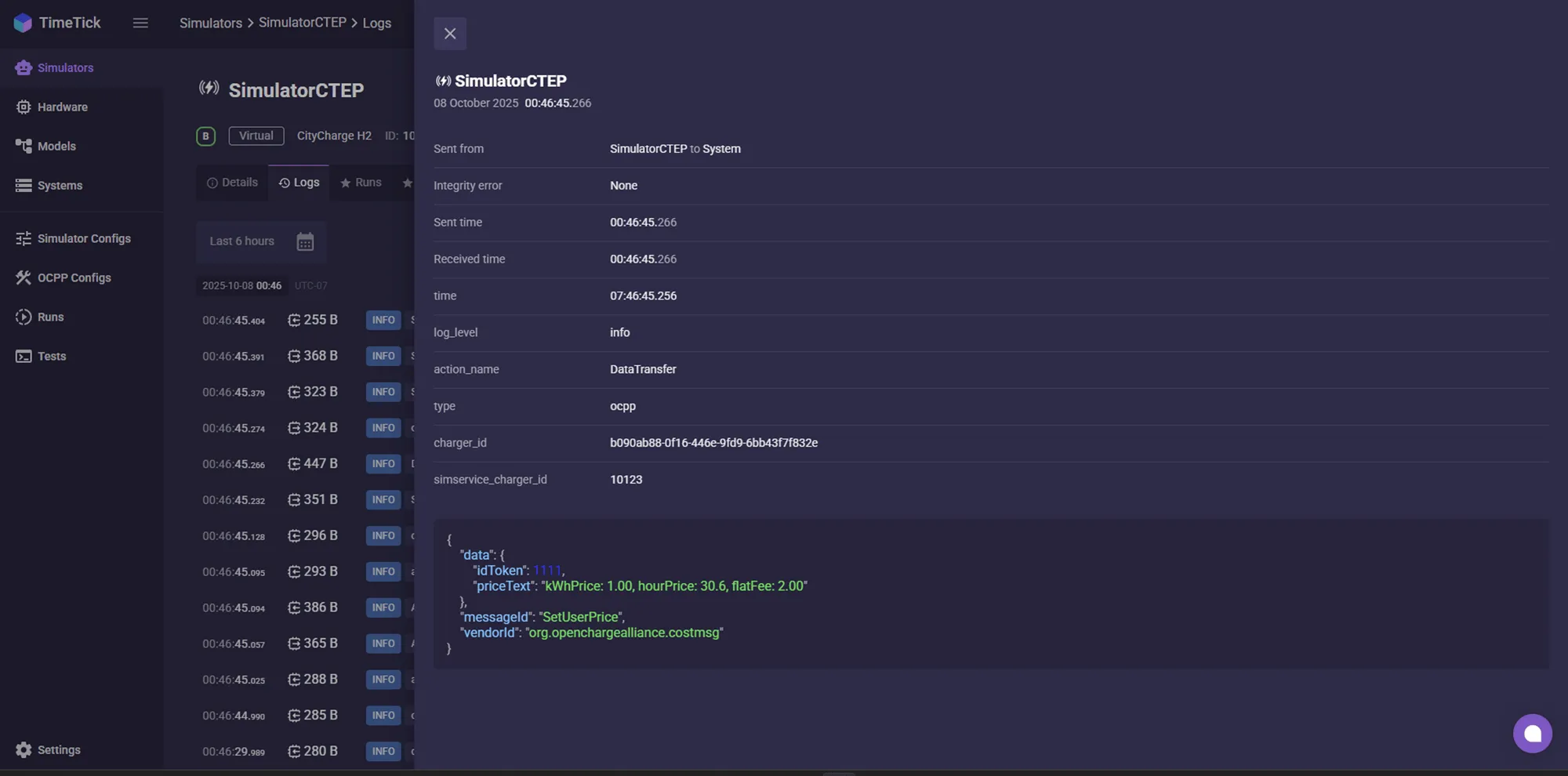
Entering the US market means meeting California's rules on price transparency. To be certified under the California Type Evaluation Program (CTEP), chargers must support the Open Charge Alliance California Pricing messages over OCPP.
- Customer trust: the stations handle the California Pricing message flow and show the rate, running cost and final cost to the driver.
- Ad-hoc payment: QR code workflows for ad-hoc payment were checked as part of the same flow.
- Virtual first: Elinta checked this logic on TimeTick simulators before moving to physical chargers, which shortened the path to market.
2. Billing integrity: Eichrecht and OCMF
In Germany, billing accuracy is a legal requirement known as Eichrecht. Charging point operators must be able to prove that meter data has not been tampered with.
Together with Elinta we implemented and validated the Open Charge Metering Format (OCMF), in which every kilowatt-hour is signed by the meter. Checking the exchange of signed meter values and public keys gives operators the legal certainty they need for commercial billing.
3. Cybersecurity: OCPP security profiles
Security is a standard requirement for operators and tenders, and basic password protection is no longer enough. OCPP 1.6-J Security Profile 3 adds mutual TLS, where the charger and the backend verify each other's certificates.
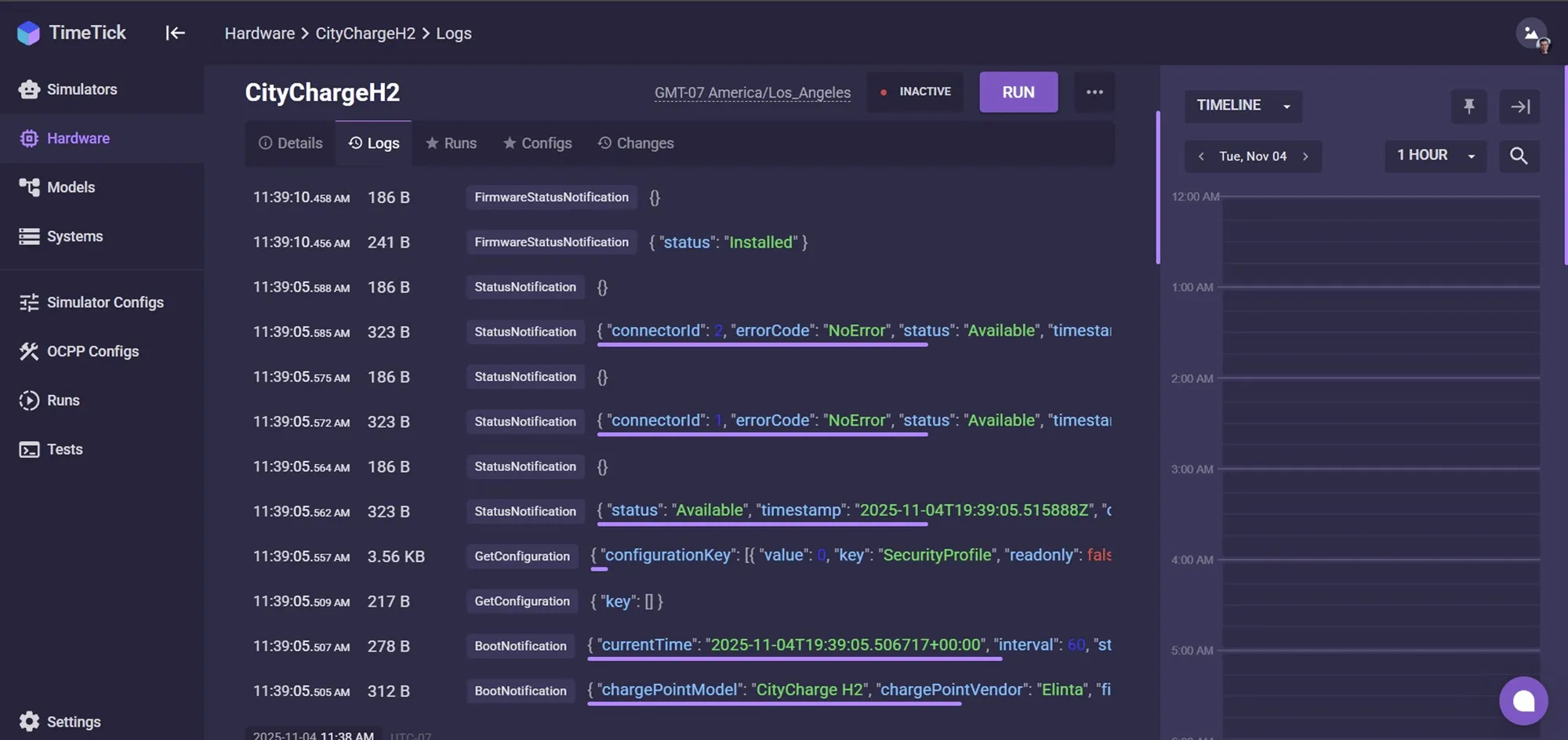
Elinta used TimeTick to read and change the security profile settings on its chargers while working toward Security Profile 3. Based on their feedback we added certificate installation to the platform, so the full mutual TLS setup can be tested from TimeTick.
4. Operational efficiency: remote firmware updates
Sending a technician to update a station costs time and money, so remote firmware updates over OCPP have to work reliably.
Elinta used TimeTick to send firmware update commands to its chargers and follow the status notifications they sent back in the charger log. This let the team debug the update flow on real chargers during firmware development.